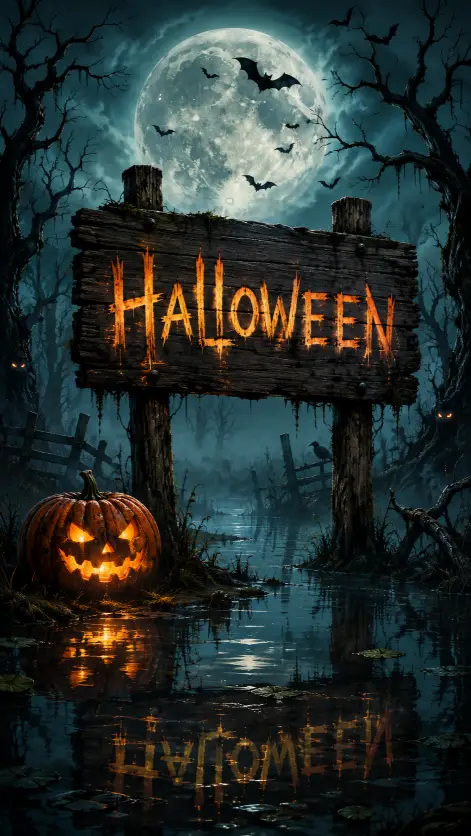
This prompt makes one carved pumpkin sitting alone on wet forest ground at night, lit only by the candle burning inside it.
I reach for it when I want something that feels like Halloween without costumes, party props, or a crowd of decorations fighting for attention. Quiet and slightly menacing is a harder look to get than most people expect.
It works well as a seasonal blog header, a phone wallpaper, or a post image that needs to feel like a real photo rather than a cartoon.
What this prompt is actually asking for
The subject is simple. One orange jack o lantern, carved, sitting on damp ground. That is the whole cast. Keeping it to a single object is what gives the image its lonely feeling, and it is also why the result stays clean instead of turning into a cluttered Halloween scene.
The face gets described in two pieces, and both matter. A jagged toothy grin means the mouth is cut with uneven points instead of a friendly curve, so the pumpkin reads as hostile rather than cute. Angry triangular eyes point the inner corners downward, which is the same trick cartoonists use to make a face look furious with two lines.
If you dropped those two details, you would still get a jack o lantern, but you would probably get the standard smiling one that shows up on candy packaging. The face wording is doing most of the mood work.
Damp forest ground is a texture instruction more than a location one. Wet leaves and soil catch light differently from dry ground. They go glossy in patches, which gives the candlelight something to reflect off and stops the bottom of the frame from turning into flat brown mush.
The candlelight line is the most important sentence in the whole prompt. It says the glow comes from inside the pumpkin and spills out through the carved openings onto the leaves nearby. That tells the image to treat the pumpkin as the light source, not just a lit object.
That distinction changes everything. A lit object sits in a scene that is already bright. A light source creates the scene around it, throwing shaped patches of orange onto the ground and leaving everything beyond its reach in darkness.
The background asks for a foggy night forest with bare tree trunks fading into deep blue black shadow. Bare trunks are the choice worth noticing. No leaves means vertical lines and empty space, which feels colder and more exposed than a full summer forest would.
Fading into shadow is a depth instruction. It tells the far trees to lose contrast and dissolve rather than staying sharp, which is exactly what happens in real fog at night.
The camera and lighting choices
Ground level, straight on, centered. Three small phrases, and together they do a lot.
Ground level means the camera sits down in the dirt at the same height as the pumpkin. You are not looking down at it the way you would if you were standing. You are eye to eye with it, which makes something the size of a football feel like it is confronting you.
Straight on means no tilt and no angle. The face points directly at the viewer. That symmetry feels deliberate and a little unnatural, the way a portrait feels when the subject stares into the lens without blinking.
Centered framing puts the pumpkin in the middle of the frame with space around it. Photographers usually avoid dead center because it can look static, but static is useful here. It reads as staged and still, which suits the mood.
The lighting instruction is one warm amber source against a palette of deep navy and charcoal. Amber is the orange yellow of a real flame. Navy and charcoal are dark blue and dark grey, not pure black.
That contrast between warm and cool is the whole visual idea. Cold blue darkness everywhere, one small pocket of warmth in the middle. Our eyes go straight to the warm spot, and everything else feels colder by comparison.
Atmospheric horror photography with heavy shadow and soft mist is the style tag. Heavy shadow gives permission for large parts of the frame to go almost fully dark instead of being evenly lit. Soft mist keeps the fog gentle and diffused rather than turning it into a thick wall.
The aspect ratio is 2:3, which is a tall vertical rectangle. It is the classic film photo shape turned upright. Vertical suits this scene because it leaves room for the trees to rise above the pumpkin and for the wet ground to spread below it.
What you will get
Expect a dark image. Genuinely dark, with maybe a third of the frame carrying visible detail and the rest sitting in shadow. If your first result looks bright and evenly lit, something in the prompt got softened, and running it again usually fixes it.
The pumpkin, the glow, the fog, and the vertical shape stay reliable across runs. Those parts are described clearly enough that they rarely drift.
The face varies a lot. Tooth count, tooth shape, and how angry the eyes actually look will shift every single time. I have had results that came out genuinely unsettling and results that came out closer to grumpy.
Fog density varies too. Sometimes the trees sit close and clear, sometimes they nearly vanish. Both look fine, so I usually run it three or four times and keep whichever balance I like.
One thing to watch for is the candle flame. Some results show the light without any visible flame inside, which looks slightly hollow. Others show a warm core that sells the effect properly.
Ways to change it
To push it colder and more supernatural, change the light description to read a pale green glow spills from inside the pumpkin onto the leaves, and swap deep navy and charcoal for near black with faint green highlights. The same scene starts feeling less like Halloween and more like something wrong is happening.
To make it lonelier, add a line saying a narrow dirt path leads away behind the pumpkin into the fog. The path gives the eye somewhere to travel and suggests that whoever left the pumpkin there has already gone.
To add rain, replace damp forest ground with rain soaked ground with water pooling between the roots, and add light rain falling through the frame catching the candlelight. Rain lit from a single source shows up as bright streaks, which adds motion to an otherwise still image.
To move the camera, replace the ground level line with shot from slightly above, looking down at the pumpkin. That flips the power balance instantly. Looking down makes the pumpkin small and pitiable rather than confrontational.
For different platforms, change 2:3 to 9:16 for Reels and Stories, 4:5 for an Instagram feed post, or 16:9 if you want it as a wide blog header. The 16:9 version needs the framing line adjusted too, because a centered pumpkin in a wide frame leaves a lot of empty space on both sides.
A few things worth knowing
Words like angry, jagged, and horror occasionally trip safety filters even though nothing here is violent. If a run gets blocked, swapping angry triangular eyes for sharp triangular eyes and horror photography for moody night photography usually clears it without losing much.
Vertical crops sometimes cut the top of the tree trunks awkwardly. Adding tall trunks visible in the upper third of the frame gives the composition a bit more structure.
If the ground looks too clean, add scattered fallen leaves and small twigs around the base of the pumpkin. Real forest floors are messy, and the mess helps sell the photo.
I keep coming back to this one because it does not need much to work. One pumpkin, one flame, and a lot of dark space around it.