This is a children’s portrait prompt built around one decision: the sun sits behind the subject instead of in front of her. Almost everything else in the wording exists to support that.
The tree, the hand on the bark, the meadow dissolving into soft colour, all of it is there to hold up a single lighting idea. Take the backlight out and the image goes flat and ordinary.
I reach for this one when I want something that looks like a real family snapshot rather than a posed studio portrait. It works well as a sample image for a photography portfolio mockup, a header for a parenting or outdoor blog, or just practice at writing light into a prompt.
What this prompt is actually asking for
Naming an age, around five, does more than it seems. It sets the face and body proportions, because kids that age have rounder cheeks and larger eyes relative to the head. Writing child on its own leaves that open, and you get a wider spread of ages back.
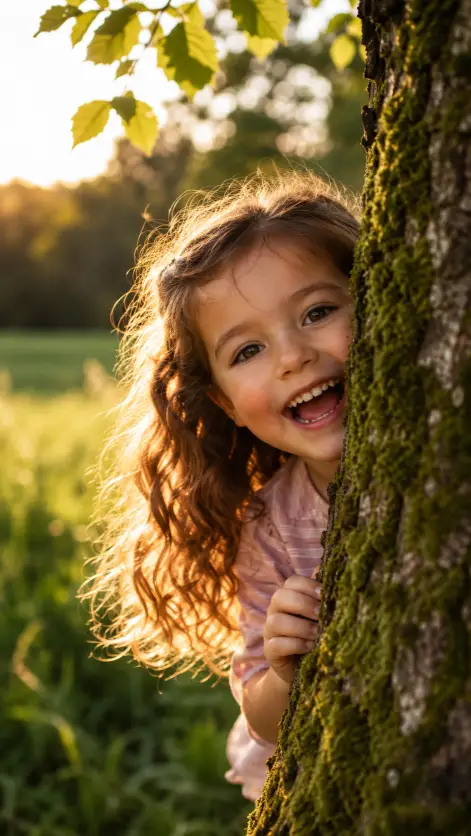
The peeking pose is the heart of the image. She is partly hidden by the trunk, which puts something solid in the foreground, and foreground objects are what give a flat picture a sense of depth.
The one small hand gripping the bark is worth keeping. Hands are the part most likely to come out wrong in a generated image, so specifying a single hand doing one simple thing gives the tool less room to invent an extra finger.
The wide open smile is an expression instruction, and without it you usually get a neutral or faintly serious face. That small change turns a candid moment into a formal portrait.
Long curly light brown hair catching the sun is doing two jobs at once. It describes her, and it tells the light where to land, because curls with sun behind them catch bright edges in a way straight hair never does.
The soft pink striped top is a colour decision as much as a clothing one. Pink sits opposite green on the colour wheel, so she lifts away from the meadow instead of sinking into it.
Where the camera sits
Eye level means the lens is at the same height as her face, roughly a metre off the ground. That puts the viewer inside her world rather than looking down from adult height, and it is the single biggest difference between a photo of a child and a photo taken by someone who did not bend their knees.
Close in tells the tool to fill the frame with her. There is no room left for a wide view, so the meadow becomes texture rather than a place you could walk around in.
The tree filling the right side is a composition note. It pushes her to the left, which leaves her space to look into, and it anchors one edge of the frame so the picture does not feel like it is floating.
That leafy branch hanging into the top corner is a small detail with a large effect. Real outdoor photos almost always have something intruding at an edge, and that slight untidiness is a big part of why an image reads as a photograph instead of a render.
What the backlighting does
Backlighting means the sun is behind her, aimed roughly at the camera, rather than lighting her face. It is the opposite of what most beginners do, and it is the reason this prompt looks the way it does.
A low sun sits near the horizon, so the light comes in sideways and passes through the edges of her hair. That produces a bright rim around her outline, sometimes called a hair light or a halo.
Her face ends up in soft open shade, which is flattering on a kid. No hard shadows under the eyes, no squinting, because she is not staring into the sun.
Shallow depth of field is the blurry background effect. Only a thin slice of the scene around her stays sharp and everything behind it melts. Bokeh is the word for what out of focus highlights turn into, those soft round blobs of light, and in a sunlit meadow they come out green and gold.
Warm natural colour keeps the whole thing leaning yellow rather than blue. It stops the image looking cold or clinical, which is the default drift on a lot of outdoor scenes.
What you will get
A tall vertical image with her on the left, bark texture down the right side, and a wash of soft green and gold filling everything behind her. The glow through the hair is usually the first thing you notice.
The pieces that hold steady across runs are the pose, the vertical frame, the pink top, the blurred background and the general warmth. Those are all stated plainly enough that they land nearly every time.
The pieces that wander are the expression, which can come back as an open laugh, a closed grin or something in between, and how much of her body is visible. Sometimes you get head and shoulders, sometimes half her torso.
Flare is the other variable. Every so often the sun lands directly in the frame and washes out a corner, which either looks lovely or wrecks the shot. There is no middle ground, and no way to predict which you get.
Check the hand on the bark before using anything. Even with a single hand called out, fingers are still where these images fall apart most often.
Ways to change it
For a cooler, softer version, replace the backlighting line with flat overcast daylight with no direct sun and soft even shadows. The glow disappears, but the colours get gentler and the whole thing feels quieter.
To move it out of the woods, swap the mossy tree for peeking around the corner of a weathered wooden fence with a garden behind her. The pose survives the change, and you keep the foreground depth.
For autumn, change the background line to the meadow behind her blurred into orange and rust bokeh with dry grass. Pair that with a mustard yellow knit cardigan in place of the pink striped top and the palette holds together.
If you want a different feel from the camera, try shot from slightly below her eye level, looking up past the branch. That makes her seem taller and adds sky behind, though you lose some of the meadow blur.
The aspect ratio is the easiest swap. The vertical 9:16 shape suits Reels and Stories, 4:5 fits an Instagram feed post better, 1:1 gives you a square, and 16:9 turns it into a wide blog banner.
A few things worth knowing
Pick the aspect ratio before you generate rather than cropping afterwards. A tall frame composed for phone screens loses the branch and most of the meadow the moment you crop it wide.
Some generators are stricter about images of children than others and will decline the request no matter how ordinary the wording is. That is the tool working as intended, and there is no clever rewrite worth chasing there. If yours refuses, use a different one or shift the subject to an older age.
The moss is a detail that sometimes takes over. If the trunk comes back looking more like a swamp than a tree, cut mossy down to a lightly mossed tree trunk and it settles.
I keep coming back to this prompt because the lighting idea inside it moves easily. Once you have seen what a low sun behind the subject does to hair, you start writing it into everything.