A kid hiding behind a flower sounds like the easiest picture in the world. It is not. The gap between playful and awkward is narrow, and most of the wording in this prompt exists to keep the image on the playful side.
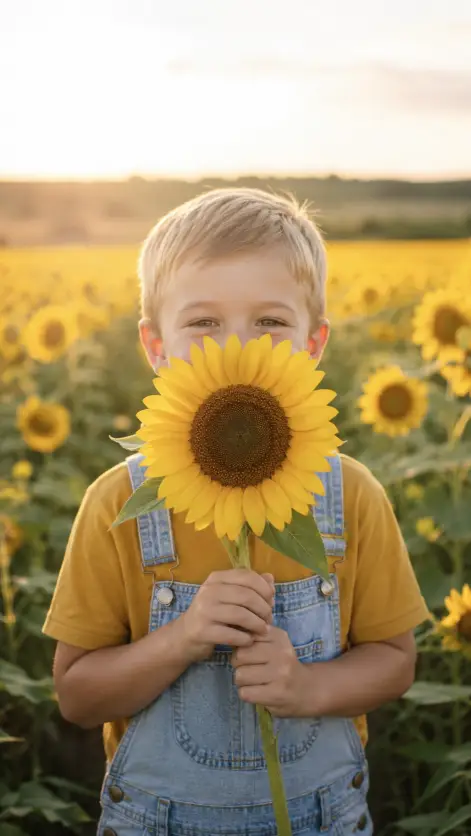
What you get here is a warm summer portrait that looks like someone’s dad took it on a good evening with a decent camera. Nothing staged, nothing studio lit, just a bright field and a kid being a kid.
I use this kind of prompt for seasonal content, blog headers in July and August, and vertical posts that need to feel friendly without trying hard.
What this prompt is actually asking for
The subject is set as a boy around six years old. Naming the age is doing real work. Left out, most generators land somewhere around nine to twelve, and the proportions shift with it. A six year old has a rounder face and a larger head relative to the body, which is a big part of why the picture reads as sweet.
The pose is the centre of the whole thing. He holds one large sunflower up in front of his face so only his eyes and a small smile show past the petals. Partial hiding like this gives the viewer something to complete in their own head, which is why these images hold attention longer than a plain smiling portrait.
Specifying one large sunflower matters more than it looks. Say flower and you might get a small one that covers nothing. Say flowers and you might get a bunch clutched in both fists. One large one is the version that works.
The hair is described as short and light blonde. Hair colour is worth stating because with most of the face covered, the hair becomes the main identifying feature in the frame. Blonde also sits close to the yellow of the petals, which keeps the palette tight.
Clothing is an ochre yellow t shirt under light denim dungarees. Ochre is a muddy, earthy yellow, darker than the sunflower petals. That small difference stops the shirt from blending into the background. Dungarees are the overalls with the bib and shoulder straps, and they read as childhood shorthand in almost every culture, which is why they show up in so many family shoots.
The framing is waist up. That crops out the legs and keeps the flower, the face and the field doing all the talking. It also avoids the messy middle distance where generators tend to produce strange limb work.
Behind him, rows of sunflowers stretch out and blur. That blur is called shallow depth of field, and it just means only the subject is sharp while everything behind falls soft. It is the single biggest reason an image looks like it came from a real camera rather than a phone.
The camera and lighting choices
The camera sits at his eye level. For a six year old, that means the camera is low, roughly a metre off the ground. Without that line, the default is an adult standing and looking down at a child, which quietly changes the feeling of the picture from meeting someone to observing them.
The light comes from behind the flowers in the late afternoon. Backlighting means the sun sits behind the subject rather than in front. It puts a bright edge around the hair and the petal rims and lets the light scatter through the thin parts of the flower.
That same setup is what produces the gentle haze mentioned in the prompt. When the sun is low and pointed toward the lens, contrast drops and a soft glow spreads across the frame. Photographers chase this on purpose in the last hour before sunset.
The colour palette is pinned to warm yellow, green and pale sky. Stating a palette keeps the generator from wandering into orange sunset territory or dropping in a dramatic blue sky that would fight the mood.
The style line asks for candid lifestyle photography with natural skin tones. Candid means it should look unposed even though it obviously is. Natural skin tones is a guard against the waxy, over smoothed look that a lot of generators drift toward on children’s faces.
The aspect ratio is 9:16, so the image comes out tall. That is the shape for Reels, Stories, Shorts and phone wallpapers.
What you will get
The field, the warm yellow cast, the low sun and the tall frame come out consistent. Those parts I trust almost every time.
What moves between runs is how much of the face the flower actually covers. Sometimes you get exactly the eyes and a hint of a smile. Sometimes the flower drops to the chin and the whole face shows, which loses the idea entirely.
Hands vary too. The prompt does not say where his hands are, so you might get one hand on the stem, two hands, or a flower that appears to hover with no hand at all. Adding a line about him gripping the stem with both hands near the bottom of the frame fixes this more often than not.
The sky is the other variable. In a 9:16 crop you sometimes get a strip of pale blue at the top and sometimes nothing but sunflower heads. Both look fine, they just look different.
Ways to change it
For a cooler, quieter version, replace the light description with early morning light coming in low across the field with dew still on the petals and long soft shadows. The same scene reads calm instead of golden.
To swap the subject, write a young girl around six with dark curly hair tied in a loose braid and keep everything else untouched. The palette still holds because the clothing colours carry it.
For a different field, try a row of tall lavender stalks with a single stem held up in front of her face. You lose the yellow and gain purple and grey green, which suits a softer feed.
To change the angle, use shot from slightly below, looking up past the sunflower heads toward the open sky. It makes the flowers tower and gives the picture a child’s eye sense of scale.
For platform fit, 4:5 gives you a tall feed post with more room on the sides, 1:1 crops square, and 16:9 turns it into a wide blog header where you would want to place him off to one side.
A few things worth knowing
Prompts involving children sometimes trip safety filters even when the scene is completely ordinary, and that is worth expecting rather than being surprised by. Keeping the wording plain and descriptive, as it is here, is the best way to avoid it. Words about clothing detail and posture should stay simple.
Do not add a line asking for a close up of his face. It contradicts the flower cover and the generator will usually pick one instruction and ignore the other, which produces a half committed result.
If the flower keeps landing too low, try describing it as held high, petals level with his forehead. Giving a position relative to the face works better than asking for the face to be hidden.
This is one of those prompts I run three or four times and pick from. The good version is very good, and the misses are usually just the flower sitting in the wrong place.