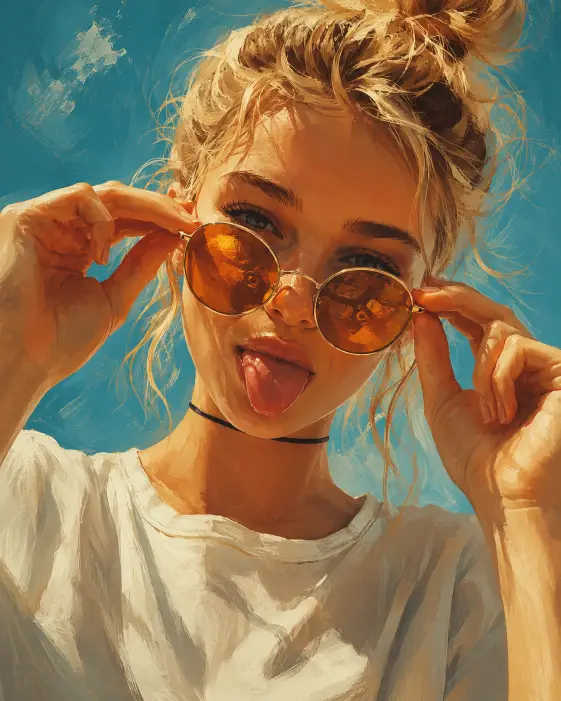
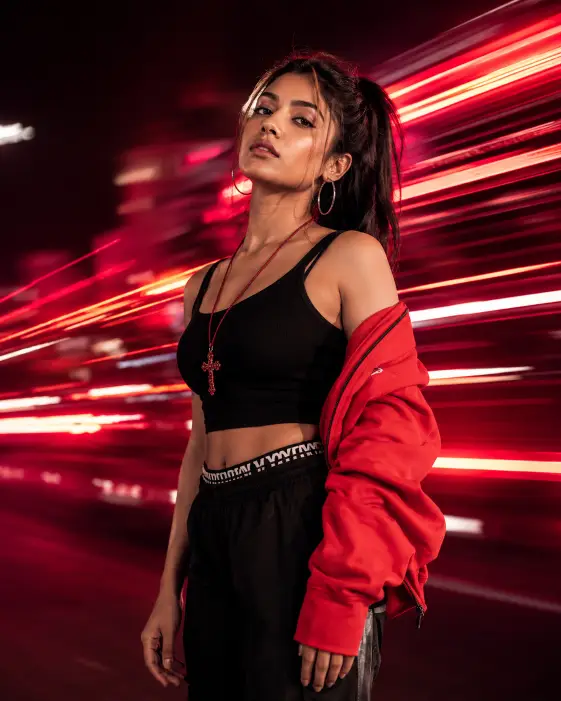
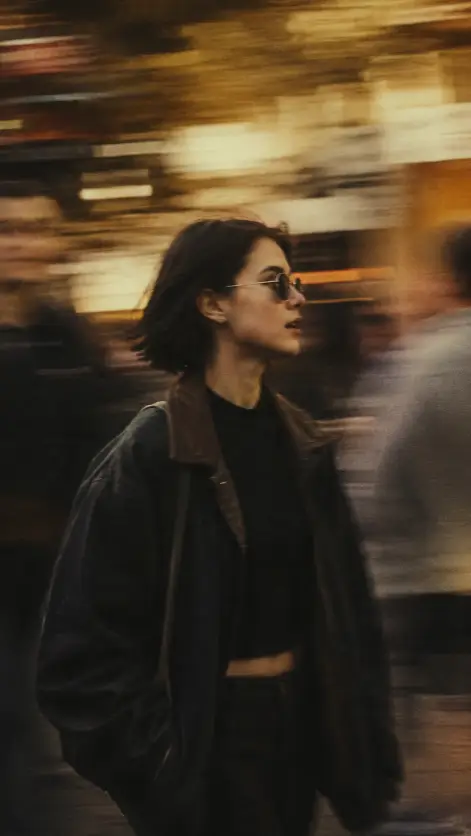
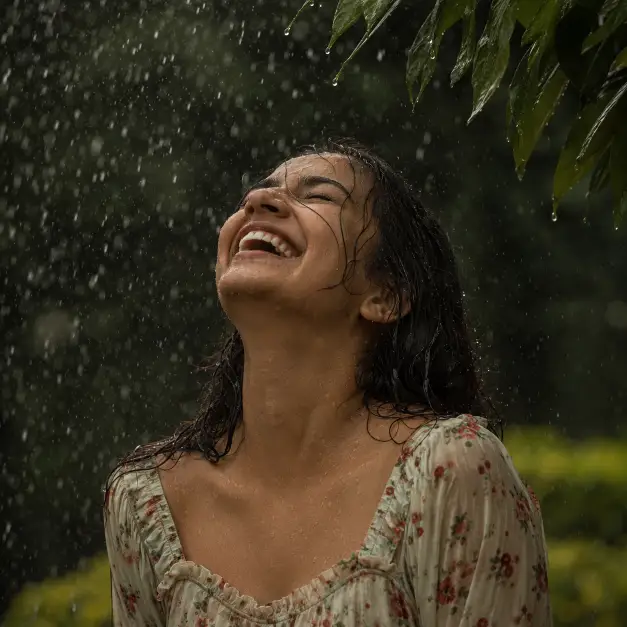
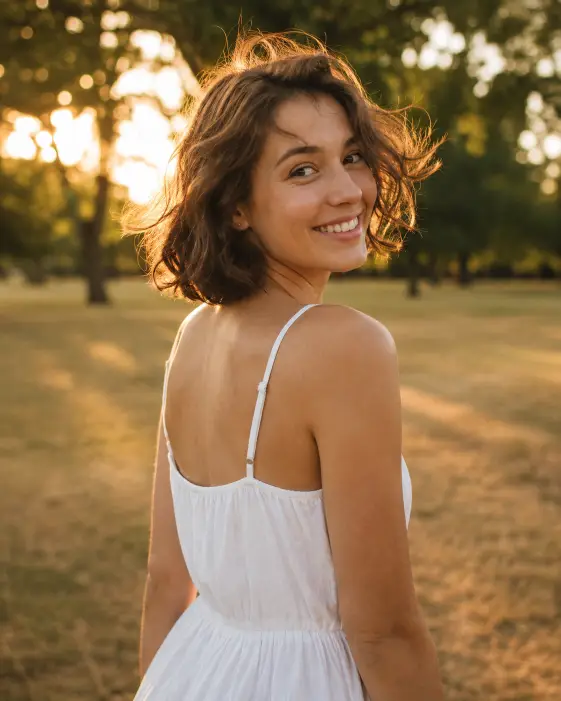
Some selfie prompts try too hard and end up looking like a studio shoot with a phone taped to a tripod. This one goes the other way. It asks for a photo that looks like it was taken mid laugh, one handed, outdoors, with nobody thinking too hard about it.
I ran it a few times and the thing it gets right most often is the feeling of a real moment. The hair tuck, the upward glance, the sunlight sitting on the skin. Those three details do most of the work.
It suits anyone building a lifestyle feed or a personal brand page. It is also a good prompt to study if you want to understand why some AI portraits feel staged and others do not.
What this prompt is actually asking for
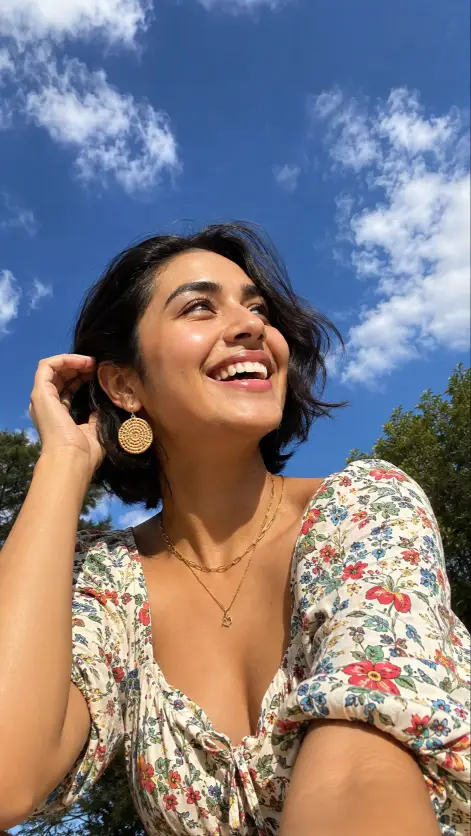
The subject is described simply. A young woman with a short dark bob. A bob is a cut that stops around jaw level, and naming it matters, because without a stated hair length these images tend to default to long loose hair every single time.
Then comes the action, and this is the important part. She is smiling widely and tucking her hair behind her ear with one hand. Giving the hands a job is one of the easiest ways to make a portrait look candid. A person doing something with their hands reads as caught mid moment, while a person with hands at their sides reads as posing.
The clothing is spelled out in real detail. Cream blouse, colorful floral print, puffed sleeves. That combination sets the mood as warm and casual rather than formal, and puffed sleeves give the shoulders shape, which fills a close crop nicely.
The accessories are small but they matter. Two thin gold necklaces layered together, plus one woven statement earring. Statement here just means large and eye catching. Because the head is tilted and the hand is lifting hair away from one ear, that earring often lands near the middle of the frame, which is probably why the prompt asks for one rather than a matched pair.
The expression instruction is doing something clever. She is looking upward and away from the camera with a natural laugh. Direct eye contact makes a photo feel posed. Breaking that eye contact makes it feel like someone else pressed the shutter at the right second, even though the framing still says selfie.
The camera and lighting choices
The camera is held low and tilted up, close to her face, at arm length. That is the exact geometry of a real selfie taken outdoors, and it produces a specific look. Tilting up puts sky behind the head instead of buildings or clutter, and it slightly sharpens the jawline.
Close and at arm length also means the face fills a good portion of the frame. There is a mild distortion that comes with holding a lens near a face, and that distortion is part of why the result reads as a phone photo rather than a professional portrait.
The light is bright midday sun with clear highlights on the skin. Highlights are the shiny bright spots, in this case across the forehead, cheekbones and nose. Photographers usually call midday sun bad light because it is harsh, but it is the honest light for this kind of picture, and asking for it stops the image drifting into soft golden hour territory.
The background is a deep blue sky with scattered white clouds and green treetops at the edge of the frame. Those treetops are worth noticing. Pure sky behind a head looks flat and slightly fake, so a bit of green along one edge gives the eye something to hold and makes the scene feel like an actual place.
The style line asks for a natural lifestyle photo with true to life color. That is a request for no filter, no teal shadows, no heavy grading. Skin looks like skin and the sky looks like sky.
What you will get
Expect a bright, warm, close crop of a laughing face against blue sky, in a tall vertical frame. The 9:16 ratio is the same shape as a phone screen, so it fills a Reel or a Story with no cropping needed.
The parts that stay steady across runs are the hair length, the direction of the sunlight, the sky, and the general mood. Those are described clearly enough that they hold.
The parts that wander are the floral print, which comes out different every time, and the earring, which sometimes turns into two earrings or a shape that does not quite make sense. The hand doing the hair tuck is also worth checking. Hands near hair are one of the harder things for image models to keep clean, so look at the fingers before you post anything.
Ways to change it
For a cooler, quieter version, replace the light and background lines with late afternoon light casting long soft shadows, and a calm sea with a low horizon behind her. The laugh still works, but the whole image drops a few degrees in temperature.
To move it indoors, swap the sky for a window seat in a bright kitchen with soft light coming from one side and blurred plants behind her. Keep the hair tuck. It reads just as candid inside as it does outside.
For a different age and mood, change the subject line to a woman in her forties with silver streaked shoulder length hair, and change the blouse to a plain linen shirt in soft olive. The structure holds fine, only the styling shifts.
If you want this for an Instagram feed post rather than a Story, change the ratio to 4:5. Use 1:1 for a square grid tile, and 16:9 for a blog header, though the tight face crop suffers a bit at that width.
A few things worth knowing
Close selfie crops sometimes lose the second necklace entirely. If both chains matter to you, describe one shorter chain sitting at the collarbone and one longer chain hanging below it, rather than leaving it as two.
The upward gaze occasionally goes too far and you end up with visible white under the iris, which looks unsettling. If that happens, soften the wording to looking slightly up and off to one side.
Bright midday sun can also blow out the forehead into a flat white patch with no detail in it. Adding a line asking for detail retained in the brightest areas usually pulls that back.
I keep coming back to this one because it works as a baseline. Change the clothes, change the sky, keep the hair tuck and the broken eye contact, and it stays candid every time.