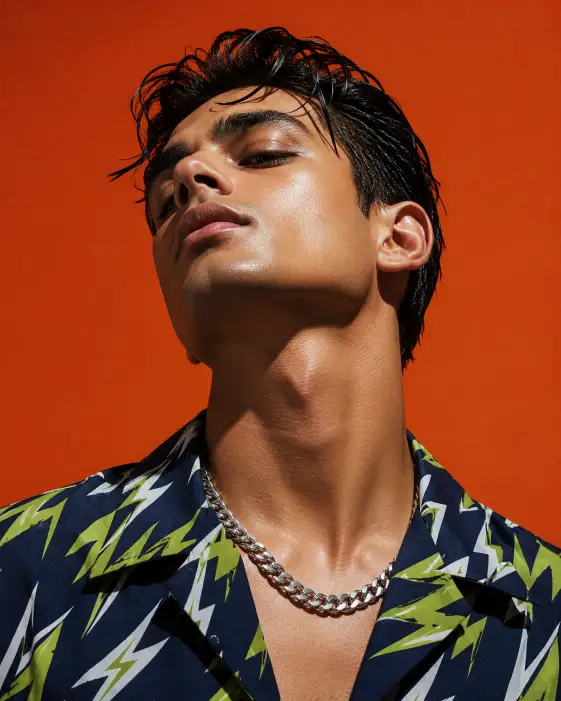
This one makes a loud, tight studio portrait. A man shot from the shoulders up, chin raised, standing against a flat orange wall in a printed shirt, lit from overhead so the shadows drop hard down his neck.
It suits anyone chasing a magazine cover feel rather than a soft, natural headshot. The color clash does most of the heavy lifting, and the pose does the rest.
What I like about it is that it does not leave the awkward parts to chance. Head tilt, chin height, shoulder position and camera height are all named, and those four things are exactly what usually go wrong in AI portraits.
What this prompt is actually asking for
The crop is shoulders up. That is a beauty crop, close enough that the face and neck fill nearly the whole frame with no room for arms or body. Everything you notice is the jaw, the collar, and the chain.
Then the pose. Head tilted back, turned a little to one side, chin lifted, shoulders squared to the camera. Head back with a raised chin reads as looking down your nose at someone, which is the cool, slightly aloof attitude fashion editorials run on.
The squared shoulders matter more than they sound. Without that line, a tilted head usually drifts into a lean, and the whole thing looks like the subject is pulling away from the camera instead of facing it down.
The small turn to one side stops the face from going flat and symmetrical. Dead straight-on portraits look like ID photos, and a few degrees of rotation is all it takes to fix that.
The shirt is an open-collar camp shirt. A camp shirt is the boxy short sleeve type with a flat collar that lies open at the neck, the shape people usually call a bowling shirt. The open collar leaves the neck and upper chest bare, which is deliberate, because the lighting is built to carve shadows across exactly that area.
The print is named down to the colors: navy, lime green and white in an abstract lightning pattern. Naming the colors is what ties the shirt to the wall behind it. Leave that out and it invents a print, usually something muddy that fights the background.
The chunky silver curb chain is the finishing detail. A curb chain is the classic thick one with flat interlocking links, and it works here because polished metal picks up a sharp highlight under hard light. A thin delicate chain would vanish at this crop.
Wet-look hair pushed back with a few strands falling forward keeps the styling looking intentional rather than messy. The glossy dewy skin is the beauty editorial signature, that shine sitting on the cheekbones, nose and forehead. It only reads well under hard light, which is why the two are paired.
The camera and lighting choices
Shooting from a low angle means the camera sits below the subject’s chin and points up. That makes a person look taller and more commanding, and it sharpens the jawline into a cleaner edge.
Paired with a lifted chin, that effect doubles up. Sometimes it doubles up too much and you end up looking straight up the nose. I have had runs where the angle went further than I wanted, and toning down the chin line is the easiest fix.
Hard lighting from directly above is the other half of the look. Hard light means a small, undiffused source, so shadow edges are crisp instead of fading out gently. It is the difference between midday sun and an overcast sky.
Placing it overhead pushes shadow into the eye sockets, under the nose, under the chin, and then straight down the neck in a defined band. It is dramatic rather than flattering, and that is the point.
If you swapped it for soft light, the pose and the crop would stay but the image would lose its edge completely. The shadows are the reason this looks like a shoot rather than a snapshot.
The background is a flat, saturated orange wall. Flat means no gradient, no texture, no vignette creeping in at the corners. Saturated means the orange stays strong instead of drifting toward beige.
Orange sitting behind navy is a straight complementary pairing, opposite sides of the color wheel, so it clashes on purpose while still holding together. The lime green then cuts through both as the accent that keeps it from feeling too tidy.
The 4:5 aspect ratio is the tall portrait rectangle, the tallest shape an Instagram feed post can use before it gets cropped. For a close portrait it is a good fit, since the extra height gives the head room to breathe.
What you will get
The consistent parts across runs are the palette, the flat orange wall, the tight crop, the raised chin attitude and the overhead shadow pattern. Those are locked in tightly enough that you rarely get a run that misses them.
The face is completely up to the tool, since the prompt never describes age, features or ethnicity. If you want a particular look, that needs adding.
The shirt pattern varies the most. Abstract lightning is a loose instruction, so some runs give clean geometric zigzags and others give scattered literal bolts. The chain thickness and how wet the hair looks also drift a bit run to run.
The most common problem I hit is shadows going too heavy, with the eyes disappearing under the brow. Adding a line asking for a small amount of fill light to keep the eyes visible clears it up without softening the rest.
Ways to change it
Changing the wall changes everything, and it is the fastest edit. Try a flat, saturated deep teal studio wall, then update the palette line to read teal, cream and rust so the shirt colors follow instead of clashing badly.
For a less punishing look, replace the lighting line with hard studio lighting from the side at roughly forty five degrees. You keep crisp shadow edges but they run across the cheekbone rather than down the neck, which is far kinder to the face.
If the low angle keeps overshooting, swap it for shoot at eye level with a tight crop. The attitude of the raised chin survives, and the nose problem goes away.
The clothing swaps cleanly too. An open-collar camp shirt printed with a bold red, cream and black abstract flame pattern gives you the same energy in a warmer register, and it sits nicely against a deep blue wall.
For other platforms, 9:16 gives you a full Stories or Reels frame, 1:1 gives a square, and 16:9 turns it into a wide banner. The 16:9 version needs a looser crop to work, so change shoulders up to head and chest visible.
A few things worth knowing
The glossy dewy finish sometimes tips over into looking sweaty or oily, especially under this much overhead light. If a run comes back greasy, change it to clean skin with a soft natural sheen.
Chin lifted high is another line that gets taken literally. Softening it to chin lifted slightly usually lands closer to what most people picture.
Flat backgrounds have a habit of picking up a faint gradient anyway. Adding even lighting across the background with no gradient at the end of the prompt tends to hold it in place.
Nothing here trips safety filters, so this is one you can run repeatedly without rewording it, which is not true of every fashion prompt.
I would run this one four or five times before picking a keeper. The pose and lighting land more often than not, but the shirt print is the coin toss, and it is worth waiting for a good one.