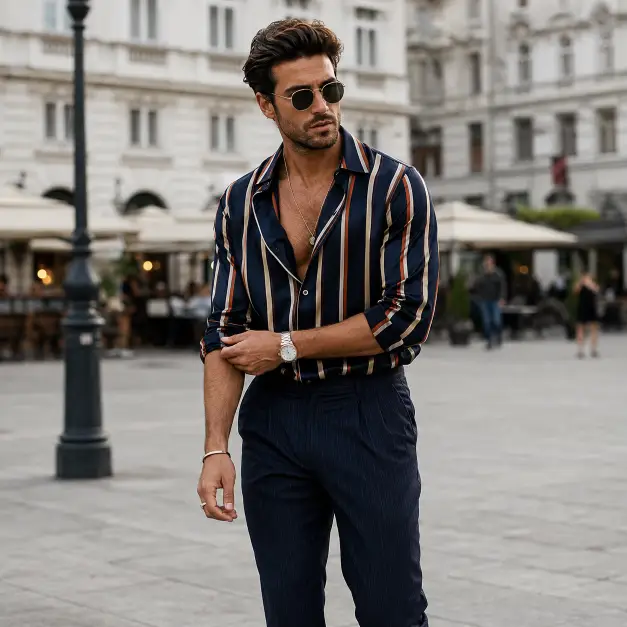
This prompt makes a clean, expensive looking street photo of a man crossing an open plaza in a striped satin shirt. It reads like a menswear brand shot rather than a holiday snap, and that is the whole point of it.
I like it because the styling work is already done for you. You are not asking for a nice photo of a guy outdoors and hoping the result looks put together. You are handing over the shirt, the trousers, the jewelry, the light, and the lens.
It suits a menswear feed, a fashion mood board, or a personal brand photo where the outfit carries as much weight as the face.
What the prompt is asking for
Three-quarter length means the frame cuts him somewhere around the knee or mid thigh rather than at the chest. That matters more than it sounds. A head and shoulders crop would hide the trousers and the tuck, and half the outfit would be gone.
The walk through an open plaza gives the image space. Without it the background would close in and the photo would feel like a portrait taken against a wall instead of someone moving through a real place.
The hand adjusting the rolled cuff is doing quiet work. Hands are the part of a generated photo most likely to look strange, and giving one hand a specific job usually settles it down. The other hand stays relaxed at his side, which stops the pose from looking staged on both sides.
Turning the body slightly to the camera is the classic fashion angle. Square on to the lens makes people look wide and stiff. A small turn narrows the shoulders and adds a bit of depth to the chest and arms.
The clothes and the styling
The satin shirt is the loudest instruction here. Satin has a sheen, so it catches the light in soft bands down the sleeves and across the chest, and that sheen is what separates this from a plain cotton shirt photo.
Vertical stripes in navy, cream, and rust do two things at once. They stretch the frame downward, which makes him read taller, and they lock the color scheme in before the background even shows up.
Unbuttoned at the chest with the sleeves rolled to the elbow keeps everything relaxed. It also ties directly into that cuff gesture, since you cannot adjust a rolled cuff on a sleeve that is buttoned at the wrist.
The loose tuck into dark navy pinstripe trousers is a small detail I would not remove. A sharp tuck reads formal and a little rigid. A loose one keeps the shirt soft around the waist and matches the rest of the pose.
The pendant, white dial watch, and silver bracelet are there for small points of shine. The white dial in particular tends to sit right in frame because of the raised arm, so it becomes a bright accent near the middle of the photo rather than something hidden at the hip.
Round tinted sunglasses and a swept back textured quiff finish the look. The quiff adds height at the top of the frame and keeps the silhouette from ending flat.
The camera and lighting choices
Eye level means the camera sits at the same height as his face. The photo then feels like a person looking straight at him, not looking down at him or up at him, and that neutral height is what most fashion photography uses.
An 85mm lens is the standard portrait length. It slightly flattens facial features in a flattering way and pulls the background closer while keeping it soft, which is why faces shot on it rarely look stretched.
Soft late afternoon light is low, warm sun near the end of the day. Shadows go long and gentle instead of hard and black under the nose and chin, and the warmth plays well with the rust stripes.
Shallow depth of field is the blurred background effect. Only a narrow slice around him stays sharp and everything behind melts, and honestly this single instruction does most of the work in making the image look like a real camera made it.
The background and color
A blurred European square with a white classical building, a black street lamp, and cafe umbrellas is a smart choice because all three shapes survive being out of focus. Big pale stone, one dark vertical line, a few round canopies. You still read the place at a glance.
The palette of deep navy, cream, and rust keeps the shirt, trousers, and setting in the same family. Without that line you often get a background that fights the outfit for attention.
What you will get
Across runs, the reliable parts are the framing, the striped satin shirt, the warm low light, the blur behind him, and the general sense of an old European square.
The parts that move around are the face, the exact width and count of the stripes, how much jewelry actually shows, the umbrella colors, how dark the sunglass lenses come out, and the precise position of that raised hand. Any signage in the background will usually be nonsense letters, which is normal and easy to crop past.
One honest warning. Satin sometimes comes out glossier than you want, closer to a shiny party shirt than a soft one. If that happens, adding the words with a soft matte satin finish, not glossy usually pulls it back.
Ways to change it
For a cooler evening mood, replace the background line with a quiet rooftop at dusk with city lights coming on behind him, and change the light to soft blue hour light with warm lamp glow. The navy holds up well in that version.
For a lighter summer look, swap the shirt for an open weave linen shirt in olive and sand with the sleeves rolled to the elbow, and change the palette to olive, sand, and warm white.
For a stronger, more heroic feel, change the camera line to shot from a slightly low angle with a 50mm lens. Low angle means the camera drops below eye level and looks up, which adds presence but also widens the jaw, so use it lightly.
On aspect ratio, 1:1 is square and can crop the legs tighter than you expect on a three-quarter length shot. I usually switch it to 4:5 for an Instagram feed post, 9:16 for Reels and Stories, and 16:9 for a wide blog header.
A few things worth knowing
Stripes on stripes is the main risk. A striped shirt over pinstripe trousers can go muddy where the two meet at the waist. If it looks busy, change the trousers to plain dark navy tailored trousers and the outfit reads cleaner.
The unbuttoned chest occasionally trips a safety filter depending on how the rest of the prompt lands. Writing with the top two buttons open instead of unbuttoned at the chest keeps the same look and usually goes through without trouble.
Sunglasses hide the eyes, so the expression has to come from the jaw, the mouth, and the posture. If the face comes out blank, adding a calm, composed expression with a slight lift of the chin gives it something to hold onto.
I keep coming back to this one because it is forgiving. Change the shirt, change the city, keep the light and the lens, and it still looks like it belongs in the same set.