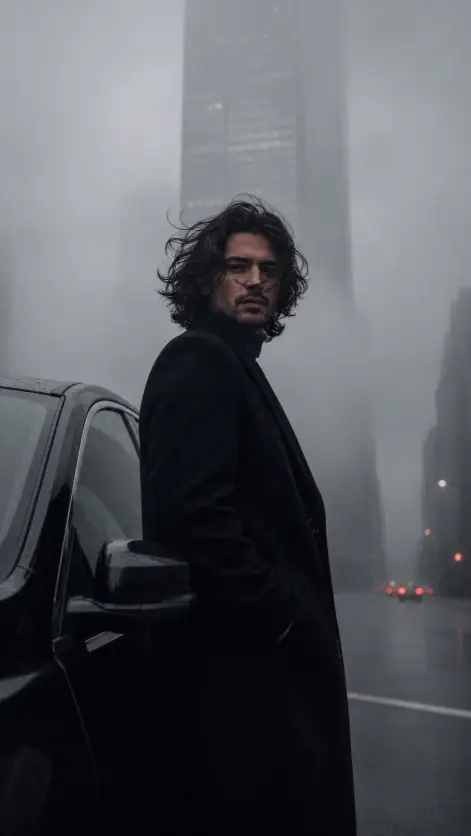
This one makes a cold, quiet street photo. A man in a black overcoat, fog on all sides, a dark car beside him, and almost no color left in the frame.
I like it because it does not need a real location. Heavy fog swallows most of the background, so you end up with a city that looks expensive without naming a single street.
It suits profile pictures, album style posts, and anything where you want a still, serious mood instead of a friendly one.
What this prompt is actually asking for
The subject is a man in his early thirties. Giving an age range matters more than it sounds. Without it you tend to get either a very young face or a blank catalogue model face, and neither one carries the tired, lived in look this photo wants.
He is standing beside a black car. The car is doing two jobs at once. It gives him something to stand near so the pose has a reason to exist, and its dark paint absorbs light, which keeps the bottom half of the frame heavy.
One hand goes in the coat pocket. Small detail, big effect. Hands are the part most image tools get wrong, so hiding one cuts the risk in half and makes the pose look relaxed at the same time.
His body is angled away while his face turns back to the camera. That twist is the whole pose. A body pointed straight at the lens reads like an ID photo. Turned away with the head coming back, it reads like someone who stopped mid walk because you called their name.
The hair is messy, shoulder length, and moving in the wind. Wind in the hair is the one thing in motion in an otherwise frozen image, and it stops the photo from looking like a mannequin standing in a coat.
Clothing is a long black wool overcoat over a charcoal grey turtleneck. Wool is worth keeping as a word because it tells the model the fabric should look heavy and slightly textured rather than plastic and shiny. The turtleneck fills the neck so there is no bright patch of skin breaking up the dark column of the coat.
The camera and lighting choices
The camera sits at chest level, which is slightly below the face. Shooting from a little under eye height makes a person look taller and more imposing. Shoot from above instead and the same man suddenly looks smaller and softer.
The framing runs from the knees up. This is a middle distance that keeps the coat, the pose, and the face all readable in one shot. Go tighter and you lose the coat entirely. Go wider and the face gets too small to matter on a phone screen.
The light is flat overcast daylight pushed through heavy fog. Flat means no hard shadows, no bright spot on one cheek with darkness on the other. Everything is lit evenly and softly, the way a street looks an hour before rain.
Fog is also working as a depth tool. Things near the camera stay sharp and dark, things further back fade toward pale grey, and that fade is what gives the photo its sense of distance.
The background holds a tall glass skyscraper that is barely visible and faint red tail lights somewhere behind him. Both are deliberately weak. They exist to suggest a city rather than show one, and the red lights give your eye one small warm point in a frame that is otherwise all grey.
Then there is the color instruction: cold grey and deep black, very low saturation, fine film grain. Low saturation means the colors are drained close to grey without going fully black and white. Fine grain adds the light speckled texture of real film, which is a quiet way of stopping the picture from looking too clean and digital.
The aspect ratio is 9:16, a tall vertical frame. That shape fits phone screens, story posts, and short video covers.
What you will get
Expect a dark, vertical, grey image with the man taking up the middle third of the frame and fog filling nearly everything else. The mood lands consistently. That part almost never fails.
The face changes on every run. It usually reads as early thirties, but features, beard, and build will differ each time, so generate it several times and pick the one you like.
The car is the least reliable element in here. Sometimes you get a clean side profile of a sedan, sometimes a strange half car shape with a door line that does not make sense. Fog hides most of the damage, but check the edges before you post it anywhere.
The skyscraper often arrives as a vague dark shape rather than clear glass, which is fine and honestly looks better. The tail lights are hit or miss and sometimes vanish completely.
Ways to change it
For night instead of grey afternoon, replace the lighting line with wet streets at night lit by a single orange street lamp, with fog catching the light. Everything turns warmer and harder, and the reflections on the car become the strongest part of the frame.
For a woman as the subject, change the opening to a woman in her early thirties and swap the clothing for a long charcoal trench coat over a black knit top. Leave the pose and the fog exactly as they are, since neither is tied to the subject.
For something less severe, change the palette line to muted warm greys and soft brown tones with low saturation. You keep the film look but lose the coldness, which reads friendlier as a profile picture.
For a feed post rather than a story, change the ratio to 4:5. Use 1:1 for square, or 16:9 if you want a wide header image, though the wide crop weakens the pose because the tall frame is part of why he looks imposing in the first place.
A few things worth knowing
Fog and low saturation both fight sharpness. If your result looks soft to the point of blurry, add crisp focus on the face and leave the rest of the prompt alone.
Heavy black clothing against a dark background sometimes merges into a single shape. Adding a thin rim of light along his shoulders separating him from the fog fixes that and costs you nothing in mood.
Nothing in this prompt is likely to trip a safety filter. It is a person standing on a street in a coat.
If the first result feels flat, it is usually the pose rather than the light. Push the body further away from the camera and let only the head turn back.