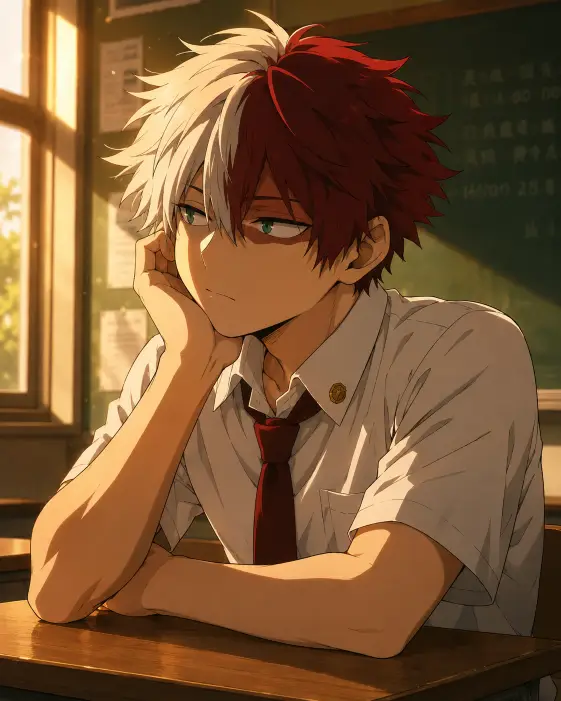
This one makes a quiet character portrait. A teenage boy slumped at his desk in the last hour of school, chin propped on his hand, clearly somewhere else in his head.
I keep coming back to prompts like this because they work without a story attached. There is no action and no dramatic pose, just a mood. That makes them easy to use as profile pictures, character sheets, or art for a story you are building.
If you write fan fiction, run a character blog, or just want an anime style avatar that does not look like everyone else’s, this is a solid starting point.
What this prompt is actually asking for
The subject line does a lot of quiet work. A teenage boy at a wooden classroom desk sets the age range, the setting, and the furniture in one go. Wooden desk matters more than it sounds, because it pushes the image toward a traditional school room instead of a modern plastic and metal one.
The pose is the heart of it. Cheek resting on one hand, the other arm folded on the desk. That single detail reads as boredom to almost anyone, and it gives the image a natural diagonal line through the shoulder and arm that keeps the composition from feeling stiff.
Staring out of frame is doing something specific too. Because he is not looking at the camera, the picture feels observed rather than posed. Ask for eye contact instead and the whole thing turns into a portrait where he knows you are there.
Half lidded eyes with a bored expression is the emotional instruction. Without it you usually get a neutral or faintly smiling face, which kills the mood the rest of the prompt is building.
The hair is the strongest visual hook. Spiky two toned hair, silver on one side and deep red on the other, is the kind of detail that makes a character look designed rather than generic. It also gives you something to hold on to if you want the same character across several images.
Calm green eyes sit against the red half of the hair, and that pairing is deliberate. Green and red sit opposite each other on the color wheel, so the eyes stay noticeable even in a small crop.
The clothing keeps things believable. A crisp white short sleeved shirt, a dark red tie, a small gold collar pin. Short sleeves quietly place the scene in warm weather, which lines up with the afternoon sun later in the prompt. The gold pin is a tiny detail, but small metal accents catch light and give the image something to make sharp.
The camera and lighting choices
Desk level means the viewpoint sits at the same height as the desktop, roughly level with his folded arm. Shooting from there puts you in the seat beside him rather than standing over him, and low angles like this read as close and personal.
Slightly to his side, framing him chest up, keeps the face large in the frame while showing enough of the desk to make the setting readable. Framed any wider and you get more classroom and less expression.
The lighting is the part I would protect if I had to trim something. Warm afternoon sunlight from a window on the left gives you a clear direction, so one side of his face lights up and the other falls into soft shadow. Directional light like this is what stops a flat, evenly lit illustration.
A green chalkboard blurred behind him gives depth without competing for attention. Blurred just means out of focus, and in illustration it comes out as softened shapes and muted color rather than true camera blur.
Soft cel shading is the term worth knowing here. Cel shading means color applied in flat blocks with defined edges instead of smooth gradients, which is what makes something look drawn rather than painted. Adding soft to it asks for those edges to be gentler, so shadows fade a little at the borders.
Warm amber tones tie everything together by pushing the whole palette slightly orange, which is why the image reads as late afternoon even before you notice the window.
What you will get
Expect a clean, modern anime frame that would not look out of place as a still from a school series. Face large, warm light across one cheek, soft green haze behind.
The parts that stay consistent are the pose, the framing, the light direction, and the general color mood. Those are described tightly enough that you will get them nearly every run.
What varies is the hair. Two toned hair split down the middle is unusual, and every run interprets it a little differently. Sometimes you get a clean vertical split, sometimes streaks mixed through, sometimes silver bangs over red at the back. If you want one specific version, say so directly, something like hair split cleanly down the middle, silver on the left, deep red on the right.
The tie color also drifts. Dark red sometimes lands closer to maroon and sometimes closer to burgundy, especially since the amber tone shifts everything warmer.
Hands are the other thing to watch. A hand pressed against a cheek is a tricky shape, and fingers sometimes come out wrong. Running it a few times and picking the best one is usually faster than rewriting the prompt.
Ways to change it
For a different time of day, replace the sunlight line with cool blue evening light from a window on the left, with the classroom lights just switched on. The amber tones line should change to cool blue and grey tones at the same time, otherwise the two fight each other.
For a female character, change teenage boy to teenage girl and adjust the shirt to a white short sleeved school blouse with a dark red ribbon tie. Everything else carries over as written.
To change the mood without touching anything else, swap bored half lidded expression for a small tired smile, eyes soft and half closed. Same pose, completely different read.
For a straight on look, change the camera line to the camera is directly in front of him at desk level, and add he is looking straight at the camera. That makes a better avatar, though it loses some of the observed quality.
The aspect ratio is set to 4:5, the tall crop that fills an Instagram feed post. Change it to 1:1 for a square profile picture, 9:16 for Stories or Reels, or 16:9 if you want it as a banner across the top of a page.
A few things worth knowing
Prompts featuring teenage characters sometimes trip safety filters even when the scene is completely ordinary, and a school setting can add to that. If it gets blocked, changing teenage boy to young man usually clears it without changing the look much.
The two toned hair is the detail most worth locking down if you plan to reuse this character. Write the exact split you want and keep that wording identical every time.
I would also keep the collar pin. It is small, but it is the kind of thing that makes a design feel intentional rather than assembled.
This is a prompt I would treat as a base rather than a finished thing. The pose and the lighting are solid enough to hang almost any character on.